I020: Does the Spiral-Arm Environment Change the Diffuse X-ray vs FUV Coupling Slope in M101?
At fixed projected radius and FUV surface brightness in M101's inner disk, do arm cells and interarm cells have different source-controlled diffuse X-ray surface brightness FUV coupling slopes ψAI? This is an archive-track question: no new XMM time requested, and no result is interpreted as a feedback mechanism or vertical position.
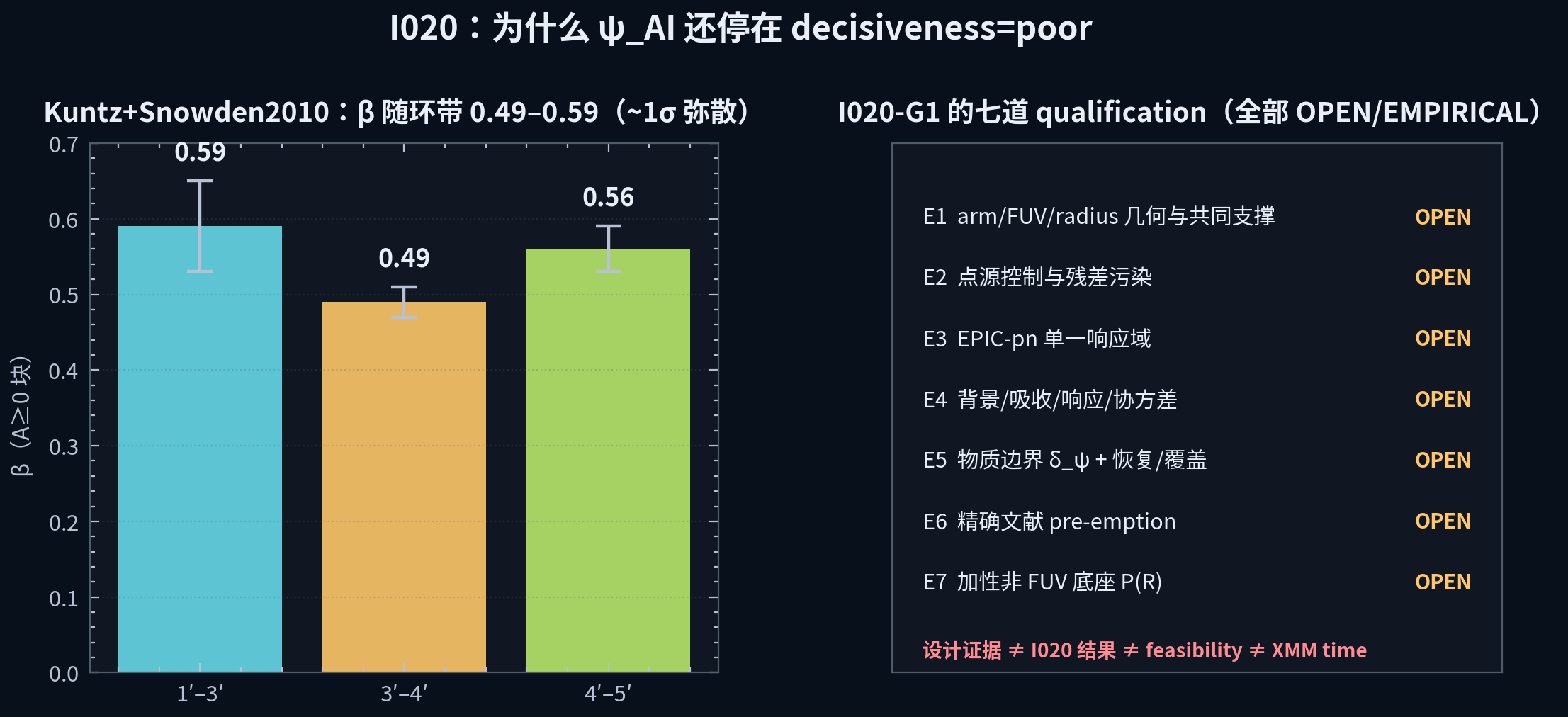
3 M101-targeted XMM Full Frame ObsIDs26 Chandra ACIS-S records (source control only)decisiveness = poor (all seven qualifications OPEN)HEAVY not authorised
At fixed projected radius and FUV surface brightness, does the spiral-arm environment in M101 change the coupling slope of diffuse X-ray surface brightness with FUV?
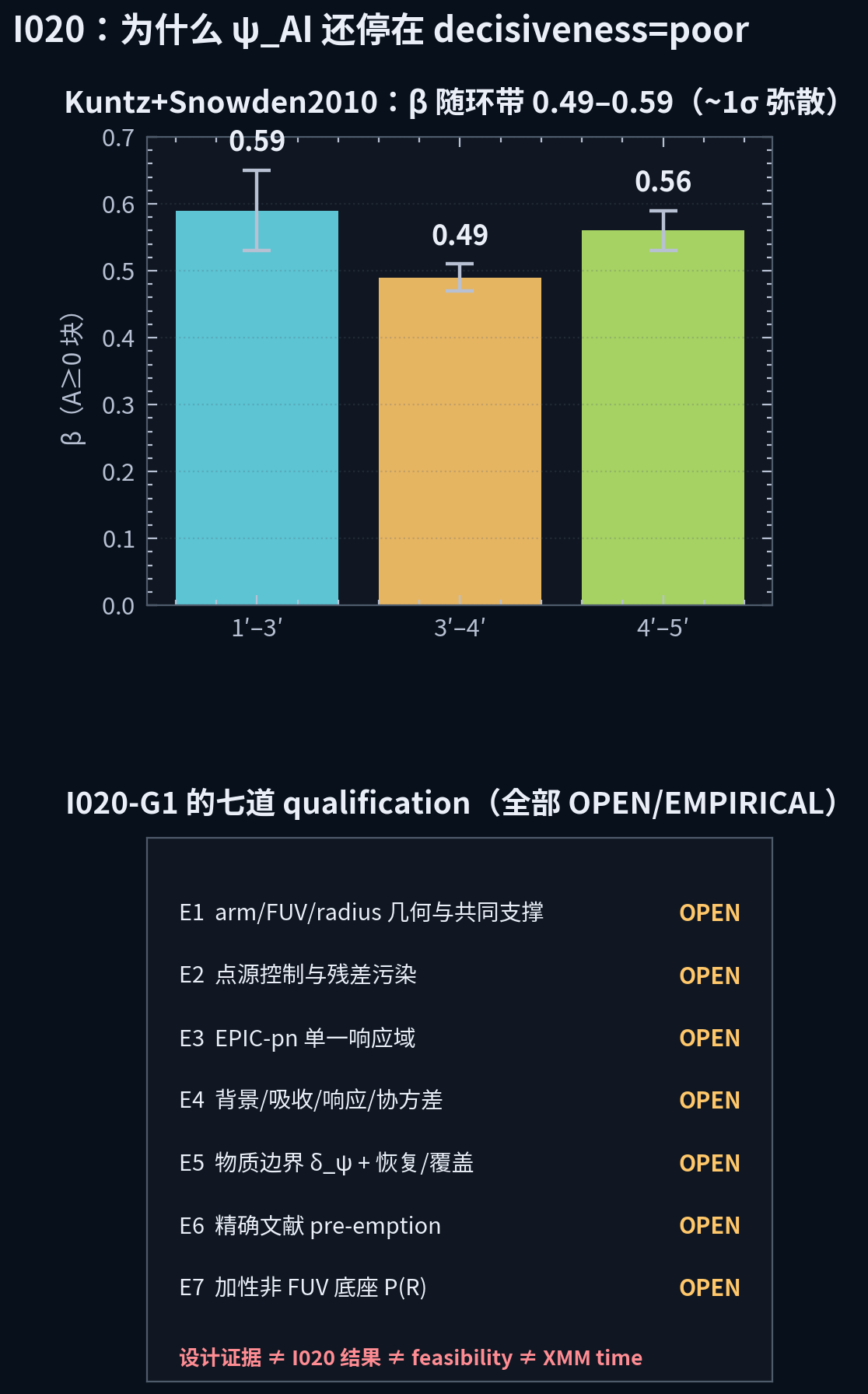
Kuntz & Snowden (2010, ApJS 188, 46) used ~1 Ms Chandra to establish M101's source-controlled diffuse X-ray power-law coupling with GALEX FUV (ΣX ∝ ΣFUVβ, β ≈ 0.55), and found an additive pedestal A(R) unrelated to recent star formation. But their stratification variable was radius, not arm state — "interarm" appears only once in 152,050 characters of text, in passing. Garner et al. (2024, ApJ 961, 217) published the full M101 arm/interarm mask construction method, but never applied it to X-ray/FUV coupling. I020 tests only a narrower premise: after controlling for radius, does the arm label change the coupling slope itself.
02 · Why It Matters
Which Published Conclusion's Scope Would Change?
If ψAI is Significantly Non-Zero (SUPPORT)
This would not overturn Kuntz & Snowden's radially-stratified coupling law; but it would limit its scope: in M101, radius alone does not absorb the arm-environment modulation of the coupling slope. Any resolved-feedback model that treats FUV–X-ray coupling as a pure function of radius must add a measured arm-phase term.
If ψAI is Consistent with Zero (WEAKEN)
If the 95% interval falls entirely within ±δψ, the result only supports this one galaxy, this one archival depth, this one response domain — that the arm label does not change the coupling slope. It does not validate a general law for face-on spirals, nor prove the absence of arm-phase effects.
Luan & Wang (2025, ApJ 986, 167) did arm-phase-resolved diffuse spectral analysis in M51 with 1.3 Ms Chandra, finding higher average temperatures in arm regions — but that is temperature stratification, not FUV coupling slope, and GALEX FUV was only a comparison image, not a regression variable. Wezgowiec et al. (2021, MNRAS 508, 6155) did on-arm/off-arm spectral extraction in M83, but likewise did not fit an arm × FUV interaction coefficient. I020's estimand has not been precisely pre-empted in the literature (E6 screened with extended vocabulary, 0 pre-empting papers).
03 · What the Archive Actually Covers
Full FoV: 30′ Diameter, Not 15′ Wide
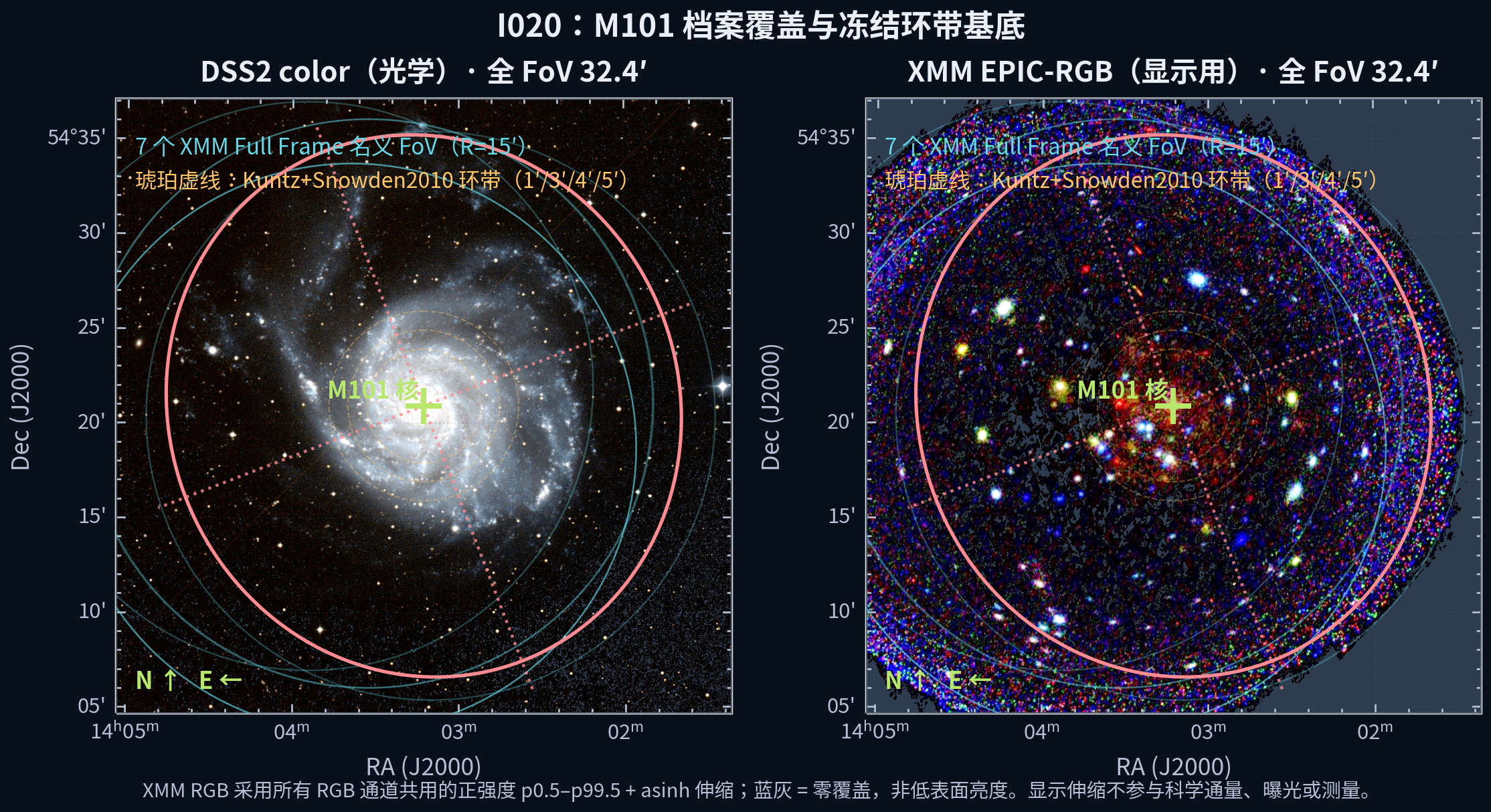
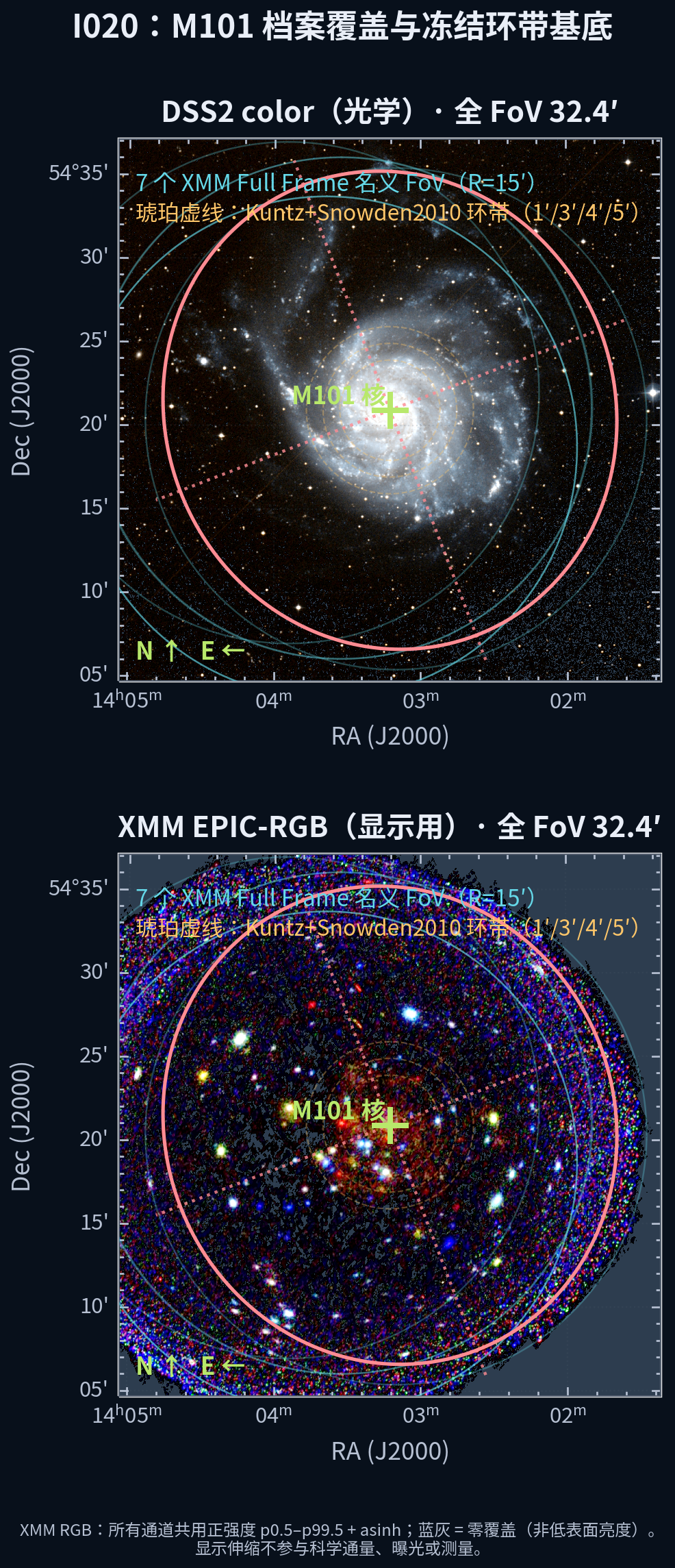
32.4′ full FoV, left and right are true HiPS2FITS WCS DSS2 color and XMM EPIC-RGB. CRVAL at M101 nucleus, CDELT1<0, CDELT2>0; N up, E left. Cyan lines are the 7 archival XMM Full Frame nominal sky circles (R=15′), not chip gaps, GTIs, masks, vignetting, or response qualification. Amber dashed lines are Kuntz+Snowden2010's 1′/3′/4′/5′ annuli — i.e., the frozen P(R) canonical basis. All aimpoints lie within the D25 ellipse (max 6.163′ = 21% of D25 major axis).
The three M101-targeted ObsIDs (0104260101, 0212480201, 0824450501) have 15′ radius nominal FoVs extending to 15.63′, 17.94′, 21.16′, all covering Garner+2024's inner-disk boundary (430″ = 7.17′). But this is only nominal geometric coverage: clean GTIs, chip gaps, source masks, response qualification — all unresolved. This page does not claim the archive is sufficient to answer ψAI.
04 · What Is Actually Measured
One Pre-Frozen Scalar Estimand
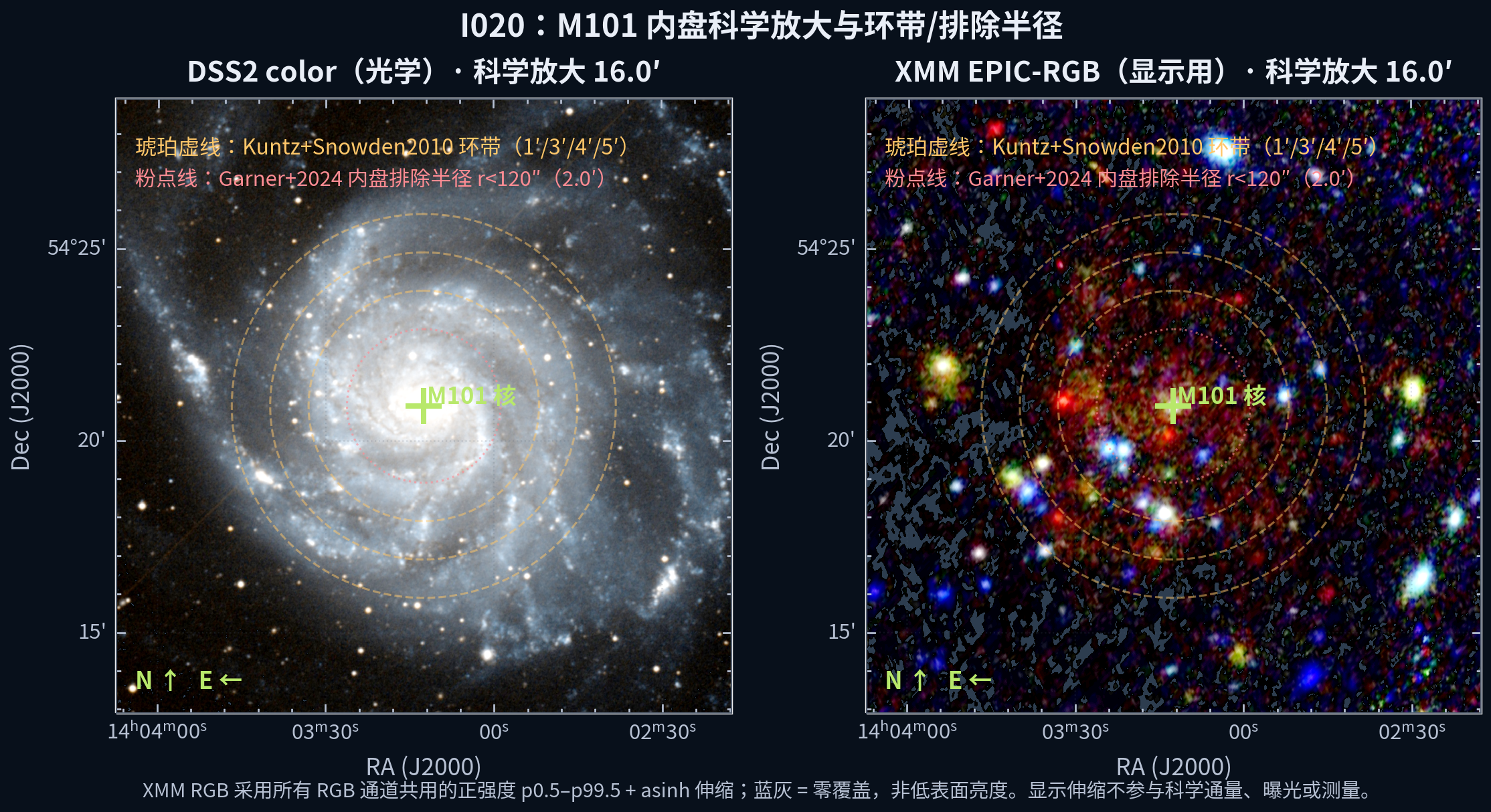
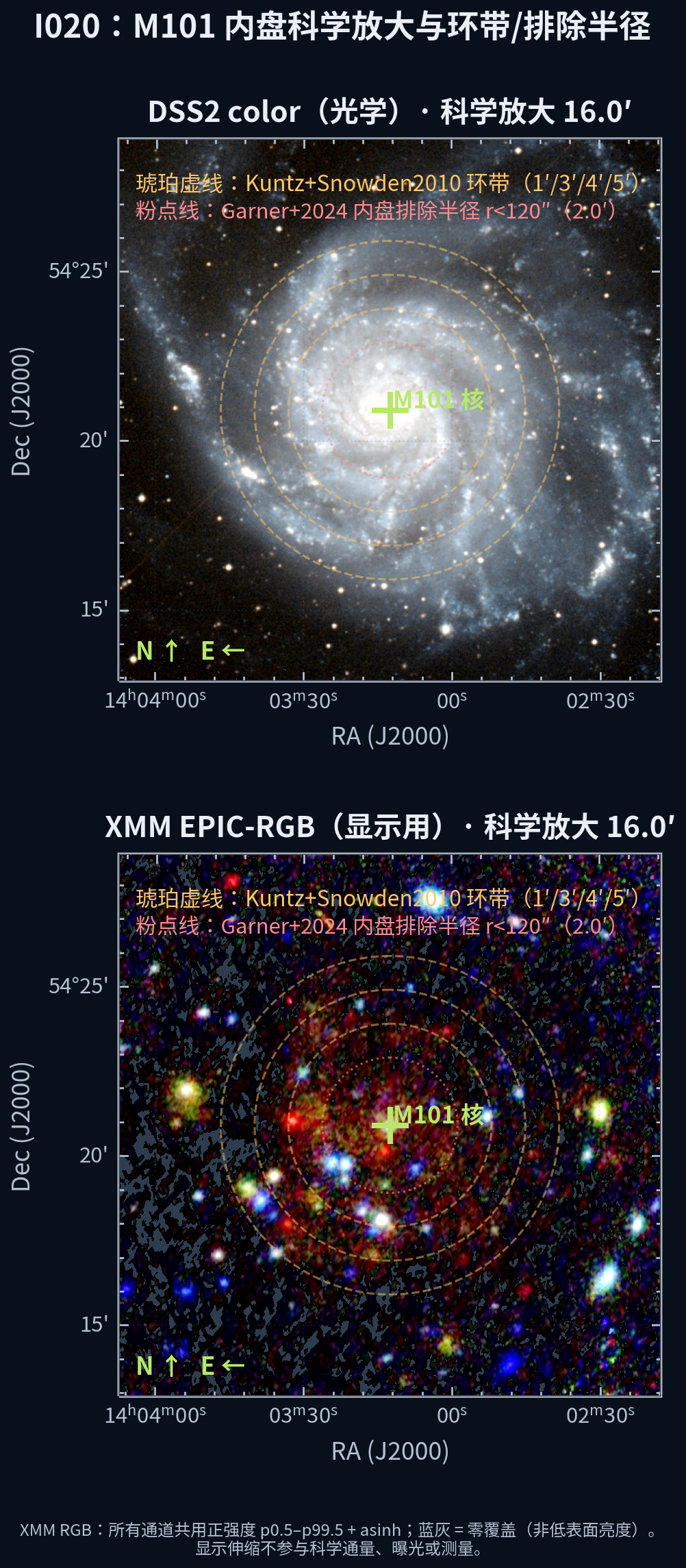
16.0′ science zoom. Amber dashed lines are Kuntz+Snowden2010's 1′/3′/4′/5′ annuli; pink dotted line is Garner+2024's inner-disk exclusion radius r<120″ (2.0′). D25 ellipse (28.84′ × 26.91′, PA=21°) exceeds the 16′ panel boundary, so not shown. Coverage overlay drawn from original WCS; XMM RGB display stretch is for display only.
The arm-minus-interarm difference in FUV coupling slope, defined on the FUV-coupled component S (not total surface brightness). Reported from the same frozen 95% CI [L, U]; not a temperature difference, not a level residual.
Materiality Boundary
δψ > 0
No external threshold for an arm × FUV interaction coefficient exists in the literature (E5 confirmed structural absence). δψ must be generated by R6 injection-recovery under the Fork-B model, not back-calculated from Kuntz error bars.
Arm environment materially changes the FUV coupling slope.
Not proof of feedback mechanism, mixing timescales, or vertical position.
WEAKEN
−δψ ≤ L ≤ U ≤ δψ
At this radius/depth/response domain, arm label does not change the coupling slope.
Does not exclude smaller effects, does not extrapolate to other galaxies.
INCONCLUSIVE
Interval overlaps boundary, non-finite, insufficient common support, recovery/coverage failure, or any qualification missing/failed
Acknowledge measurement did not establish.
Cannot infer physics from no-result.
06 · If the Answer Is the Other Way
The Most Likely Bad News Must Not Be Sugar-Coated
If the interval only contains zero, yet cannot fall within ±δψ, the most honest result is INCONCLUSIVE: the data neither excluded zero, nor pushed the residual below the materiality boundary. It does not move the credibility of "does the arm change the coupling slope"; this is precisely the branch I020 must preserve, not a packageable physical null.
The deeper risk is pedestal confusion: the additive offset A(R) quantified by Kuntz+Snowden2010 accounts for ~20% of ΣX in the 1′–3′ annuli. If P(R) ≥ 0 is not explicitly included in the model, an arm/interarm level difference would fake ψAI ≈ 0.034–0.074 (34–74% of δψ ~ 0.10), biased toward SUPPORT. The Fork-B design (I020-G1-S1) was frozen precisely to eliminate this bias.
07 · Cost and Unknowns
No New Observations Needed; One Real Archive Qualification Needed
26 Chandra ACIS-S records (1073.550 ks), for compact-source control only.
No new XMM time requested; I020 is archive track.
Still Unknown (and the Real Work of HEAVY)
E1: Executable arm/FUV/radius geometry and common support — Garner+2024 mask method published, but specific mask products unretrievable, and Hα width rule has circularity risk with FUV regression variable.
E3/E4: Clean GTIs, usable EPIC-pn products, common response domain, background/absorption/covariance.
E5/E7: δψ injection-recovery calibration, P(R) identifiability and boundary behaviour, recovery/coverage/convergence.
08 · Reproducibility
Where Every Number on This Page Comes From
Item
Actual Command Run / Fixed Input This Time
Conclusion Boundary
XMM archive
cycles/cycle-obs9/presenter_i226/publication-v2/source/archive_retrieval/raw/xsa_v_all_observations.csv (XSA TAP v_all_observations, 7 rows)
179.283 ks is observation duration, not clean time or source exposure.
Local evidence used on this page: I020 idea file, I020-G1-S1 preregistration, R3 evidence (idea-I020.md), M101 survey, source page m101-diffuse-xray-fuv-coupling.md. Static bundle manifest, figure replay, and bundle replay saved with this release; public page does not replace these canonical records.